Sunday, 20 November 2011

!!!Ten Question Trivia!!!

???????????????????????????????????????????????????????????????????????????????


1. What is the Current population of Vietnam?

2. What is the width of the Centre of Vietnam?
 a) 80 Miles
 b) 40 Miles
 c) 40 Kilometres
 d) 500 Kilometres

3. What is the name of the current Vietnamese Currency?

4. What three Religions were first to be introduced to Vietnam?
 a) Buddhism, Muslim and Taoism
 b) Taoism, Christianity and Buddhism
 c) Confucianism, Buddhism and Muslim
 d) Confucianism, Buddhism and Taoism

5. True or False? There are two types of Buddhism in Vietnam?

6. What is the name of the most popular Ladmark in Vietnam?

7. What is the Season called of which Heavy Rains and Winds occur?
8.  How many homes were damaged in the Mekong Delta flood in 2000?
 a) 215,000
 b) 10,000
 c) 815,000
 d) 750,000

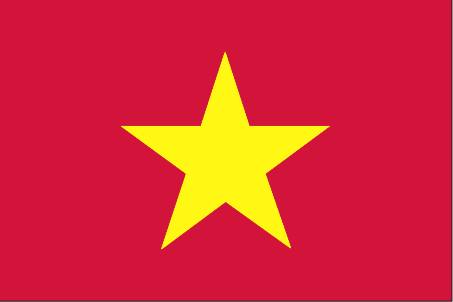
9. What are the names of the two colours on Vietnams Flag?

10. Vietnam is located in...
 a) Australia
 b) U.S
 c) Antarctica
 d) North Asia
 e) None of the Above


ANSWERS: 1. 86,936, 464. 2. 40 Kilometres. 3. Dong. 4. d). 5. True. 6. Ha Long Bay. 7. Monsoon Season. 8. c). 9. Red & Yellow. 10. e).

Various airfares to Vietnam

These airfares are from different airlines. All flights are departed from Perth W.A and are Return flights.


 Economy class

Thai Airways
Total price: $1591.40 (AUD)
Taxes: $123.56
Airfare: $1467.84
Stops: 5
Duration: 18 hours 5 minutes

Malayasia Airlines
Total price: $1774.16
Taxes: $434.06
Airfare: $1340.10
Stops: 4
Duration: 17 hours 55minutes
QANTAS
Total price: $2193.13
Taxes: $473.13
Airfare: $1720.00
Stops:4
Duration: 18 hours 5minutes

China Eastern Airlines
Total Price: $3751.05
Taxes: $270.05
Airfare: $3481.00
Stops:4
Duration:27hours

Flights may vary due to date and time.

Wednesday, 16 November 2011

Natural Disasters

Many Natural Disasters have occured in this Country. Floods and aggressive wind storms are the most popular.

One of the most effective disasters to occur over the last 60 years was the Mekong Delta Flood in 2000. This flood killed 482 people and effected over 5 million citizens. 815,000 houses were damaged or went underwater and the cost of  the damages was a total of 250 million U.S dollars.


Tuesday, 15 November 2011

Important Dates and Major Festivals

There are many important Religious day's and festivals in occur in Vietnam every year. Below is a timeline of some of the special dates that is celebrated throughout the Country.

02/01: Wrestling festival in Lieu Doi, Nam Ha.

05/01: Festival of Dong Da Hill in Hanoi. This event celebrates the anniversary of King Quong Trung's victory over almost 300,000 enemies who were trying to invade the Capitl of Hanoi.

10/01: Festival in Trieu Rhuc Village Hanoi; Cultural activities of a Traditional handcraft villiage.


13/01: Festival of Spring on Ba Den Mountain.

15/02: This important date is a formal event, it is called the Festival of Huong Pagoda, Ha Tay. It lasts over two months, it includes buffalo fighting in Tay Nquyen Highland, to highlight the martial art culture of the Vietnamese people.
10/3: Festival of Hung Temple, celebrating the anniversary of King Hungs death.

26/04: Festival of Queen Su in Chau Doc


16/06: Festival of Nghinh Ong, Tien Giang

30/07: Festival at Lang Ong, Ho Chi Minh City

09/08: Buffalo Fighting Festival, Do Son Har Phong

13/09: Festival of Keo Pagoda, Thar Binh Traditional Communal Festival.

Monday, 14 November 2011

Famous Landmarks and Places of Interest

 Top 10 Tourist Attractions


1. Ha Long Bay:
#1 of Tourist Attractions In VietnamThe bay is located in North Vietnam on a 120 kilometer long coast line. The bay is literally translated as the 'Bay of Descending Dragons'. This bay is the most famous tourist attraction in Vietnam. This location is interesting because of the Natural Landforms, there are thousands of Islands, each topped with thick Jungles, several of the islands are hollow, with massive caves.


2. Thien Mu Pagoda
Thien Mu PagodaThe Thien Mu is a Seven Story high Pagoda. A pagoda is a Hindu or Buddhist temple or sacred building. Being seven stories high makes this the Tallest Pagoda in Vietnam. The structure is located within viewing range of the Perfume River. The Temple was built in 1601 during the time when Nguyen Lords ruled the country. The Pagoda has been restructured and expanded over the years with more exciting features.


3. Hoan Kiem Lake (Hanoi)
Hoan Kiem LakeHoan Kiem Lake is one of the major scenic locations in the country. It is located in the capital of Vietnam, known as Hanoi. This landmark serves as the locals 'Favorite Leisure Spot'. Hoan Kiem means 'returned sword', this name comes from a legend where King Le Loi was given a Magical Sword by the gods, which he used to drive out the Invading Chinese. He later returned the sword to the Golden Turtle God in this lake.

4. Hoi An
Hoi AnHoi An is located on the coast of the South China Sea. It is a fishing-village-tourist-attraction which has been an International Port since the 1600's. The shipping business has since moved to the city of Da Nang. The centre of the city is still the Old Town, full of Chinese Styled Shops. It is sometimes called the 'Venice of Vietnam' because of the narrow canals that cut through the town.


5. Phu Quoc
Phu QuocLocated on the front of the Cambodia Coast, Phu Quoc is the largest island in Vietnam. The main features of this location are the untouched Coral Reefs and Tropical Forests and extraordinary beaches. One of the beaches featured in this island was chosen by the ABC news as one of the most Beautiful Beaches in the World.


6. Sa Pa Terraces.
Sa Pa TerracesSa Pa is a town located in the North West of Vietnam. There are many Rice Terraces that can be found in the Muong Hao Valley between Sa Pa Town and the Fansipan Mountain. Countless bamboo woodlands feature in this area. Local Tribes, locally known as Mountain People, grow Corn and Rice on these fields.


7. Mui Ne
Mui NeThe formerly little-inhabited beach South of the fishing village of Mui Ne has seen some development in the last 15 years or so. It has been an attraction for wind and kite-surfers because of the famous sand dunes, which have been created by the Strong Sea Breezes over the years.


Mekong River8.Mekong River (Mekong Delta)
The river is located in Southern Vietnam. The river approaches the Mekong Delta and empties the water into the sea. The area is covered with rice-fields, that produce about 50 percent of the total Vietnamese Agricultural Output. Most villages in the area are only accessible by boat on the river because the Delta is located much around the river.


9. Cu Chi Tunnels
Cu Chi TunnelsThe Cu Chi Tunnels are a series of underground tunnels located about 40km northwest of Ho Chi Minh City (Saigon). These tunnels were used as hide-outs during the Vietnam War, and were the base of opertations for the 'Tet Offensive' in 1908.


10. Nha Trang
Nha TrangNha Trang is located on the coast of Vietnam, it is the worlds most popular Seaside resort town. This location features with fine, clean sand and clean ocean water. Nha Tranhg is also a city with over 300,000 inhabitants.

Major religions

Vietnam has a different mix of major religions, this includes Buddhism, Confucianism, Taoism, Christianity and Muslim, even some indegenous religions such as Caodaism and Hao Hao. These religions have many followers and religious figures.

Where are they Practified? The major religions are usually practified in Churchs, common households and important Religious Temples placed all over the Country.

The History of the Religions. Religions in Vietnam is most importantly the Culture. The first three religions that were introduced to Vietnam were Mahayana Buddhism, Confucianism and Taoism.

The religious people of Vietnam have many routines and pray a couple to several times daily.

Buddhism: There are two types of Buddhism in Vietnam. These are Mahayana Buddhism and Therevada Buddhism.

Mahayana Buddhism reached Vietnams Red River Delta, it was brought over by the chinese around 200A.D. Mahayana is the most important and popular Religion in Vietnam.

Therevada Buddhism was influenced in Vietnam by India, between 300-600 A.D to the Mekong Delta Region. The majority of this religions followers are located in the South Delta region of Vietnam, and is mostly followed by the ethnic Khmer minority.

Confucianism: This Religion was also brought to Vietnam by the Chinese. Confucianism has held an important place in Vietnam and will help us understand alot about the Vietnamese today, it is in the Vietmanese culture which they were grown up with.

Confucianism is named after a supposed scholar and teacher who lived approximately 2500 years ago. He introduced important Ancient rights and customs, but had no religious ideas and never professed to be original.

Taoism: Taoism is believed to be founded by Cao Tsea, a chineses friend of Confucius (who was the influence of the religion 'Confucianism') about 500 B.C Prior to the communist domination. Followers usually pray 2-4 times daily.
 Many Vietnamese tended to accept all the three religious beliefs , Taoism, Confucianism and Buddhism.


 Statue of Confucious in Vietnam.


                                                                                    This is one of the many Buddhist Statues in Vietnam.

Saturday, 12 November 2011

History

The Vietnam War was the first conflict to highlight the devastating effects of modern warfare on entire ecosystems. The U.S. forces adopted a strategy of destroying Vietnamese jungle canopy, ultimately spraying "Agent Orange" and other toxic chemicals over 10 percent of South Vietnam. In addition to destroying vegetation, the public health implications of these actions (primarily birth defects, diseases, and premature deaths) have become apparent, both in the Vietnamese population and U.S. war veterans.

The defoliation campaign and other U.S. tactics in Vietnam led to an international movement for treaties that specifically protect the environment during the war. This resulted in adoption of the Environmental Modification Convention (1976), which prohibits manipulating the environment as a weapon of war, and of Protocol Additional I to the Geneva Conventions (1977), which includes a prohibition against "widespread, long-term and severe damage to the natural environment." However, many critics have called these treaties vague and impractical, and in fact they have yet to be applied to a specific case of wartime environmental damage.
 
 Vietnam War Timeline

1010 The Ly dynasty and the Chinese are repelled

1226 Tran dynasty

1288 The Mongols are defeated

1887 Creation of the Indochina Union

1932 Bao Dai, the last emperor, begins his reign

1940 Invasion of Indochina by Japan

1941 Ho Chi Minh takes power

1945 Ho Chi Minh declares independence in Hanoi

1955 Ho Chi Minh declares independence in Hanoi

1959 The communist party starts military operations in the South and construction of the Ho Chi Minh trail begins Major Dale Buis and Master Sargeant Chester M. Ovnand become the first Americans to die in the Vietnam War during the guerilla strike at Bienhoa
 

1960 Vietcong Formed (National Liberation Front for South Vietnam)

1961 Vice President Johnson Tours Saigon
President Kennedy increases US military aid to South Vietnam
Click the link for the Vietnam War Timeline
 

1973 US military withdraw

1975 Viet Cong troops enter Saigon

1976 The Socialist Republic of Vietnam is officially proclaimed

Friday, 11 November 2011

Location and Direction

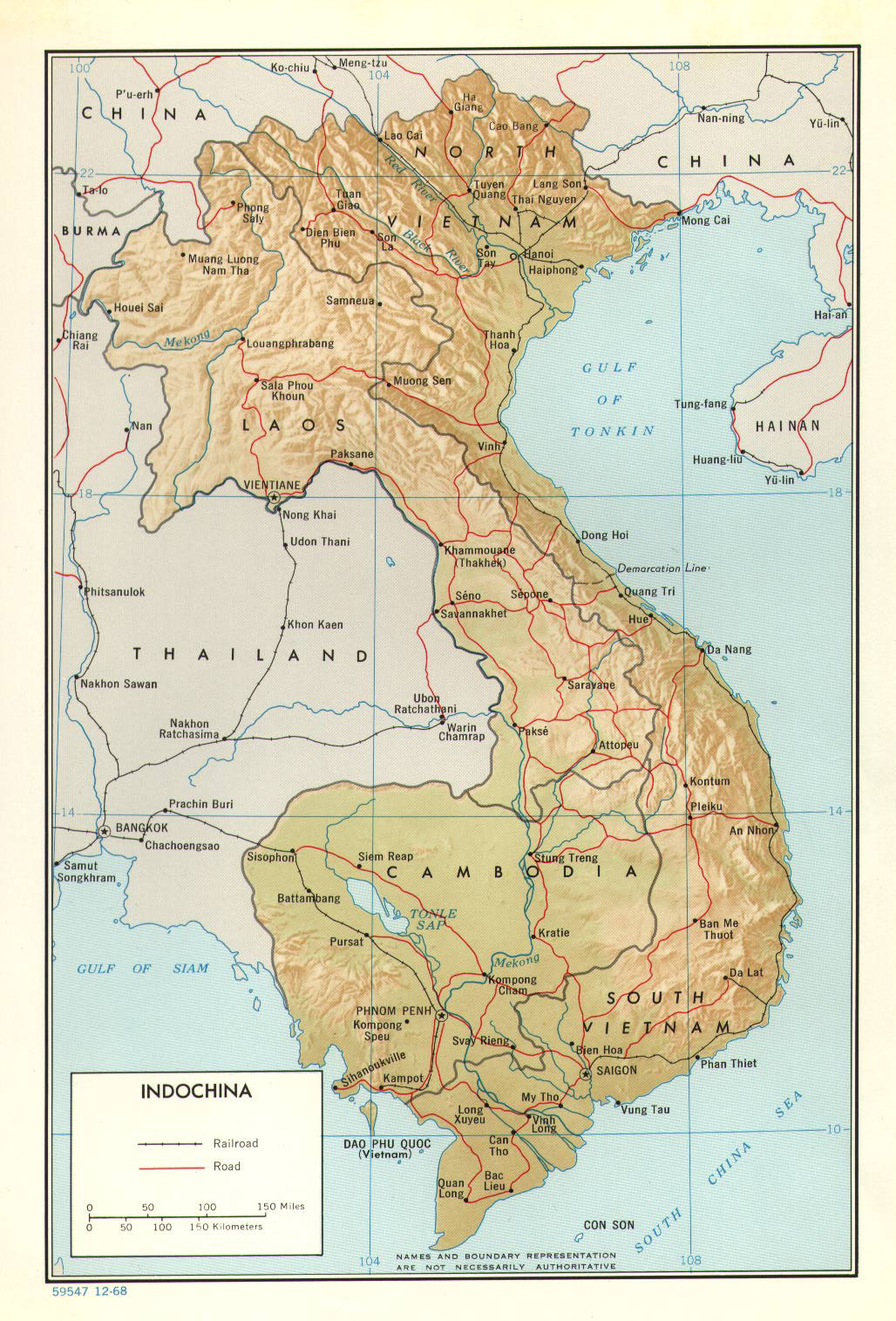
Vietnam is located in South-East Asia. It is bordered by China (North), Laos and Cambodia (West) and The South China Sea/Eastern Sea (East). Vietnam's shape is compared to a bamboo pole, having most of its area at the ends (North and South), and having very little area in the centre, being only 40 kilmetres across. The total land area of Vietnam is 329,569 km squared. The two major cities are Hanoi and Ho Chi Minh City.

Vietnams population is the second largest country in the South East after Indonesia. Vietnams current population is 86,936,464 people. The population growth is estimated to be 1.45 percent, if this rate were to continue into the future, Vietnams population would double to approximately 160 million by the year 2051.


The shortest Air Travel distance from Australia to Vietnam is 5173.07 kilometres (3214.4 miles). Flight costs from Port Hedland (Western Australia) to Vietnam are exeptionally cheap, costs being approximately $1,500-$2,000 Australian Dollars, this price is including all Taxes and Fees. Flights from Port Hedland to Vietnam occur 3-4 times each month.

Language and Currency

The name of the Currency which is used in Vietnam is called 'Dong'. This currency originated on May 3 1978, it was issued by the State Bank of Vietnam. The Dong  currently ranks as the least valuable currency in terms of its Exchange Rate. One Australian Dollar is equal to 21,257 VND (Vietnam Dong)

Languages range in the country, but the most official is called 'Khmer', the language which is also used in Cambodia. The Vietnamese use six different tones which changes the defenition and often makes it harder for Foreigners to pick up the language. Chinese and Cham are also languages which are spoken, along with other languages from different tribes in Mountain Ranges.

Thursday, 10 November 2011

Climate

Vietnam has tropical monsoon (a period of a few months containing strong winds and heavy rain) type of climate. From May-September, the Monsoon climate sets in from the south, and the country is hit strongly by South-South Easterly winds. From October-April, the north Monsoon effects the Country with North-North Easterly winds. During the short time period between the two monsoonal seasons, the winds are light.

Vietnam has a single season during the South Monsoon, rainfall is not common or light during the remainder of the year. Rainfall is over-sufficient, with Annual rainfall exceeding 1000mm per year, in almost every part of the country. Rain is even higher in the hills, especially those which are facing the seas, in the range of 2000-2500mm a year.